
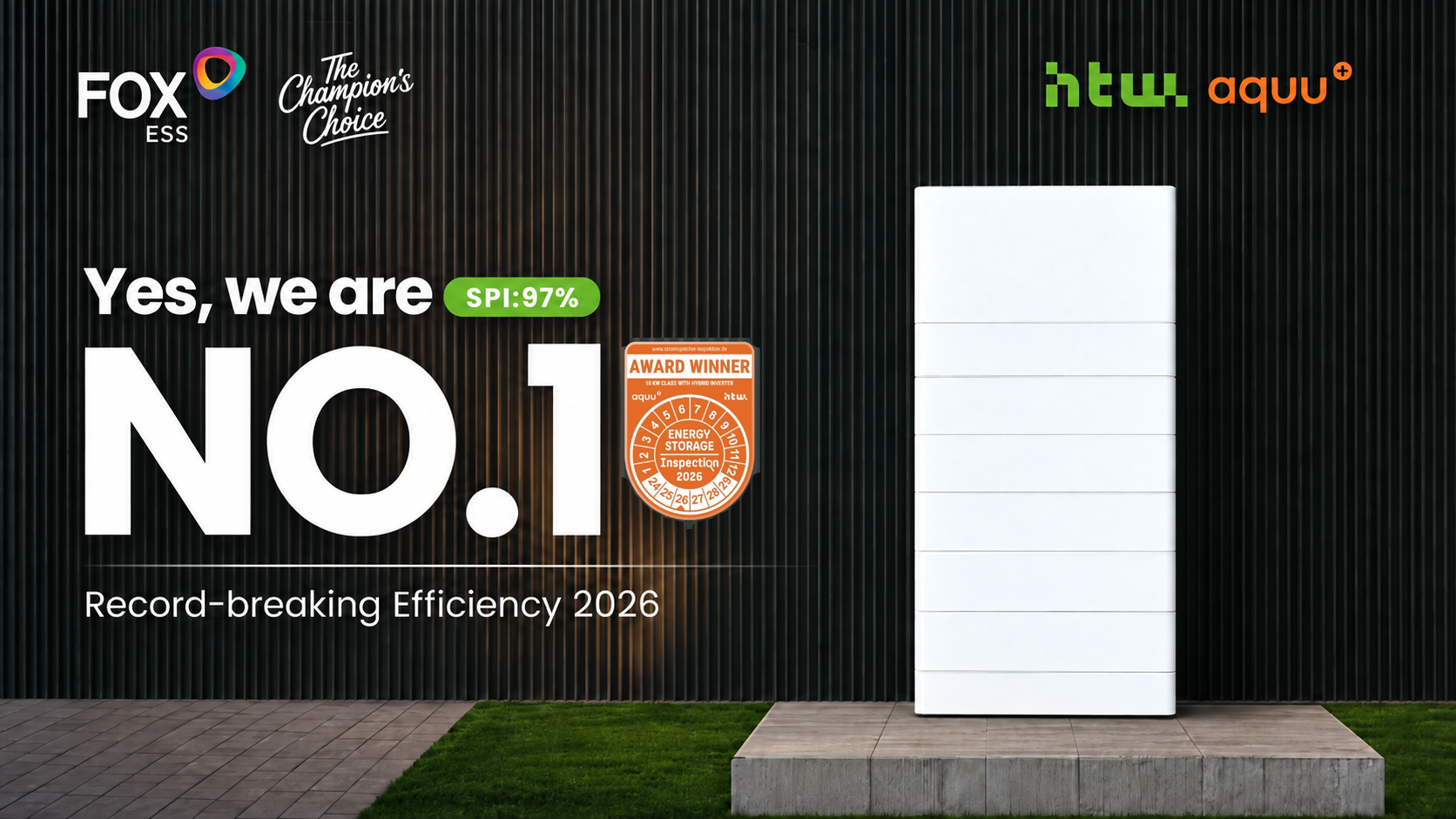








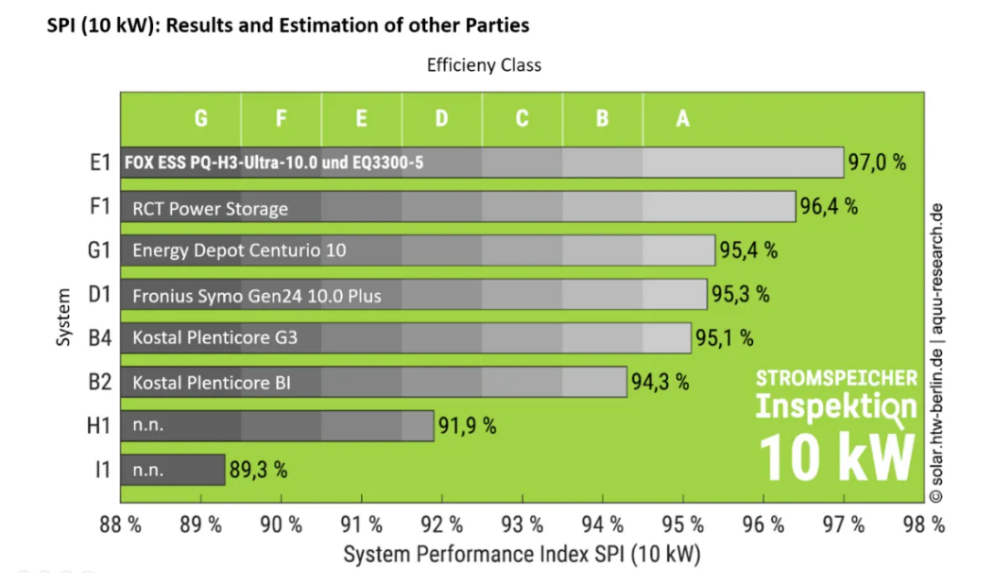
In the 2026 Energy Storage Inspection conducted by HTW Berlin and aquu, the Fox ESS PQ-H3-Ultra-10.0 inverter paired with the EQ3300-5 battery achieved a 97.0% System Performance Index.[1] It ranked first among the eight systems assessed under the 10 kW reference case, received Efficiency Class A and set a new record for the inspection.
The result is significant because the SPI evaluates the performance of a complete PV-battery system—not just the peak efficiency of an inverter or battery. It considers conversion, control, standby and sizing losses under a standardized annual reference scenario.
Fox ESS Efficiency Results at a Glance
| Metric | Fox ESS Result |
|---|---|
| Tested configuration | PQ-H3-Ultra-10.0 + EQ3300-5 |
| System Performance Index | 97.0% |
| 10 kW reference-case ranking | No. 1 |
| Efficiency class | A |
| Total assessed losses | 3.0% |
| Conversion losses | 2.7% |
| Control losses | 0.1% |
| Standby losses | 0.2% |
| Standby power consumption | 4 W |
Source: HTW Berlin and aquu, Energy Storage Inspection 2026.
What Did HTW Berlin Evaluate in the 2026 Energy Storage Inspection?
HTW Berlin’s Energy Storage Inspection is designed to compare the energy efficiency of complete residential PV-battery systems under a common methodology.
The 2026 inspection compared 12 storage systems from 10 manufacturers. Laboratory measurements were conducted by independent testing institutes in accordance with the Efficiency Guideline for PV Storage Systems. The measured data were then used to simulate how the systems would perform over a full year.[2]
The evaluation covered more than maximum conversion efficiency. It considered how system sizing, energy conversion, control behaviour and standby consumption affect overall performance at the grid connection point.
The systems were divided into two separate reference cases:
• Four systems were evaluated using SPI (5 kW).
• Eight systems were evaluated using SPI (10 kW).
The tested Fox ESS configuration ranked first specifically among the eight systems assessed under the 10 kW reference case.
Why Is the 97.0% Result Significant?
It Ranked First in a High-Performing Group
The leading systems in the 10 kW reference case were already operating at a high level:
| Position | System Performance Index |
|---|---|
| Fox ESS | 97.0% |
| Second-ranked system | 96.4% |
| Third-ranked system | 95.4% |
| Fourth-ranked system | 95.3% |
Five of the eight systems assessed under the 10 kW reference case achieved Efficiency Class A. Fox ESS therefore did not rank first in a weak comparison group. It established the highest result among several systems that had already demonstrated very good system efficiency.
At this performance level, further improvement becomes increasingly demanding. It requires losses to be controlled across several parts of the system rather than relying on one standout component specification.
It Set a New Record for the Inspection
The 97.0% SPI was not only the highest result in the 2026 10 kW reference case. HTW Berlin described it as a new record for the Energy Storage Inspection.[1]
According to Infineon, it was also the highest SPI recorded since the assessment was launched in 2018.[3]
This gives the result greater significance than an annual ranking alone. It indicates that the tested Fox ESS configuration established a new system-efficiency benchmark within the inspection’s standardized methodology.
How Did Fox ESS Limit System Energy Losses?
HTW Berlin’s detailed loss analysis helps explain why the Fox ESS system achieved the highest SPI.
| Loss Category | Fox ESS | Second-Ranked System |
|---|---|---|
| Sizing losses | 0.1% | 0.1% |
| Conversion losses | 2.7% | 2.8% |
| Control losses | 0.1% | 0.6% |
| Standby losses | 0.2% | 0.2% |
| Total losses | 3.0% | 3.6% |
The result was supported by consistently low losses across the complete system.
Conversion losses accounted for the largest share, as they did for the other systems assessed. However, the tested Fox ESS configuration limited these losses to 2.7%, the lowest figure in the 10 kW loss comparison.
Control losses were only 0.1%, compared with 0.6% for the second-ranked system. This is important because a storage system must respond efficiently to changes in solar generation and household electricity demand. Delayed or inaccurate control can lead to unnecessary electricity exchange with the grid, reducing the economic value of stored solar energy.
Sizing losses and standby losses were also limited to 0.1% and 0.2%, respectively. Together, the four categories resulted in total assessed losses of just 3.0%.
This balanced loss profile shows that the leading SPI was not created by one isolated specification. It reflected the combined performance of the power electronics, battery, system architecture and control strategy.
What Does a 97% SPI Mean for Home Energy Storage Users?
SPI is not the same as saying that 97% of every unit of electricity charged into the battery will be returned. Instead, it indicates strong overall performance within the inspection's defined test framework.
More Usable Solar Energy at Home
A household may generate more solar electricity than it needs during the day. A storage system can keep some of that surplus for evening use, when panels produce less but lights, appliances, and other household loads are still running. Efficient system operation helps limit losses as electricity is converted and stored, supporting better use of the home's own solar generation.
A More Informed Storage Investment
For homeowners, efficiency matters because stored electricity is valuable only when it can be used when needed. However, real-world savings also depend on solar output, household consumption, battery size, system settings, and local electricity prices. A high SPI is a useful comparison point, not a promise of a specific bill reduction.
Where Can High-Efficiency Fox ESS Storage Systems Bring Practical Value?
Residential Solar Self-Consumption
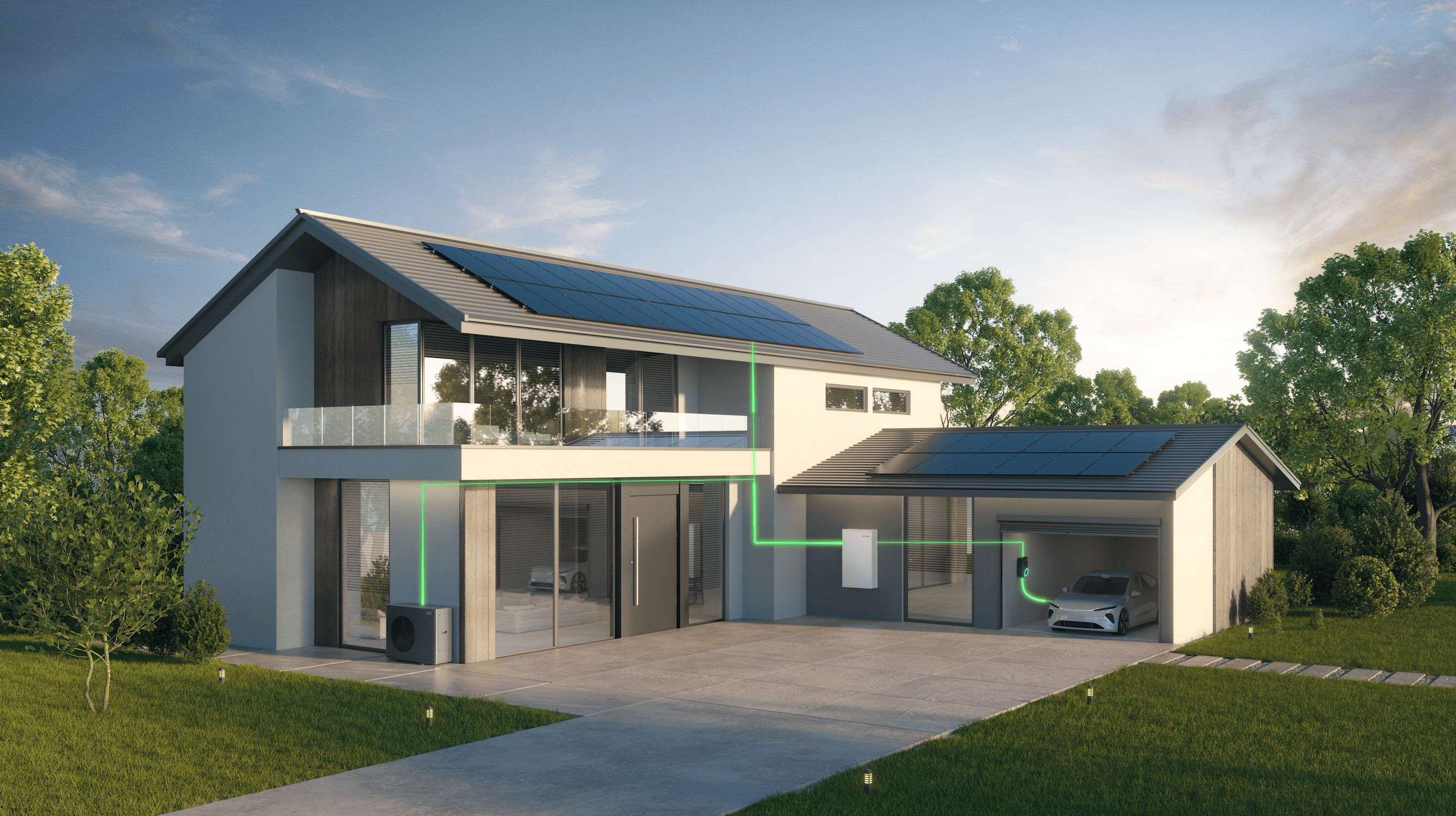
For homes with rooftop solar, a battery can store surplus daytime generation for use later. This can help households rely more on their own solar electricity and less on grid purchases when generation is low. The right battery size should reflect the home's generation and daily usage pattern.
Home Energy Management and Backup
A residential battery can help shift solar energy to the hours when a household needs it. Depending on the selected system and installation, it may also provide backup power to supported household loads. Homeowners should confirm backup output, supported circuits, and installation requirements before choosing a configuration.
Frequently Asked Questions About Residential Energy Storage Efficiency
What Is the System Performance Index (SPI)?
SPI is a system-level performance measure used in the HTW Berlin energy storage inspection. It helps compare complete battery storage systems under a defined test framework.
Is a Higher SPI Always Better?
A higher SPI indicates stronger performance in the same test category, but it should not be the only buying criterion. Capacity, output, backup needs, compatibility, installation, and cost also matter.
How Is SPI Different from Round-Trip Efficiency?
Round-trip efficiency compares the energy retrieved from storage with the energy used to charge it. SPI assesses broader system performance under the inspection's methodology. The two percentages measure different things and should not be treated as interchangeable.
Why Should Homeowners Compare Independent Test Results?
Independent tests provide a common reference beyond manufacturer specifications. Check that systems belong to the same category and were assessed using the same test method before comparing their results.
Conclusion: What Makes Fox ESS a High-Efficiency Home Energy Storage Solution?
The Fox ESS PQ-H3-Ultra-10.0 and EQ3300-5 combination ranked first in the HTW Berlin 2026 10 kW category with a 97.0% SPI and an A-class rating. Ultimately, the right solution should combine strong tested performance with a configuration that fits the household's solar generation, electricity use, and backup needs.
References
[1] HTW Berlin and aquu. Energy Storage Inspection 2026. Available at: https://solar.htw-berlin.de/publikationen/energy-storage-inspection-2026/
[2] HTW Berlin and aquu. Energy Storage Inspection 2026. Full Report. Available at: https://solar.htw-berlin.de/wp-content/uploads/HTW-aquu-PPT-Energy-Storage-Inspection-2026.pdf
[3] Infineon Technologies. “Infineon Supplies Silicon Carbide Technology to Fox ESS, Enhancing Efficiency of Residential Energy Storage Systems.” August 26, 2026. Available at: https://www.infineon.com/technology-news/2026/inftn202608-131