








If your home already has solar panels, adding a battery raises an important question: should you keep the existing PV inverter and add an AC-coupled battery, or move to a DC-coupled system built around a compatible hybrid inverter?
In general, AC coupling is often the lower-disruption option when the existing solar inverter is still suitable, while DC coupling can provide a more integrated solution for a new solar-plus-storage installation or an inverter replacement. Neither approach is universally better.
The right pathway depends largely on the home’s existing equipment and future energy plans.
What Is an AC-Coupled System?
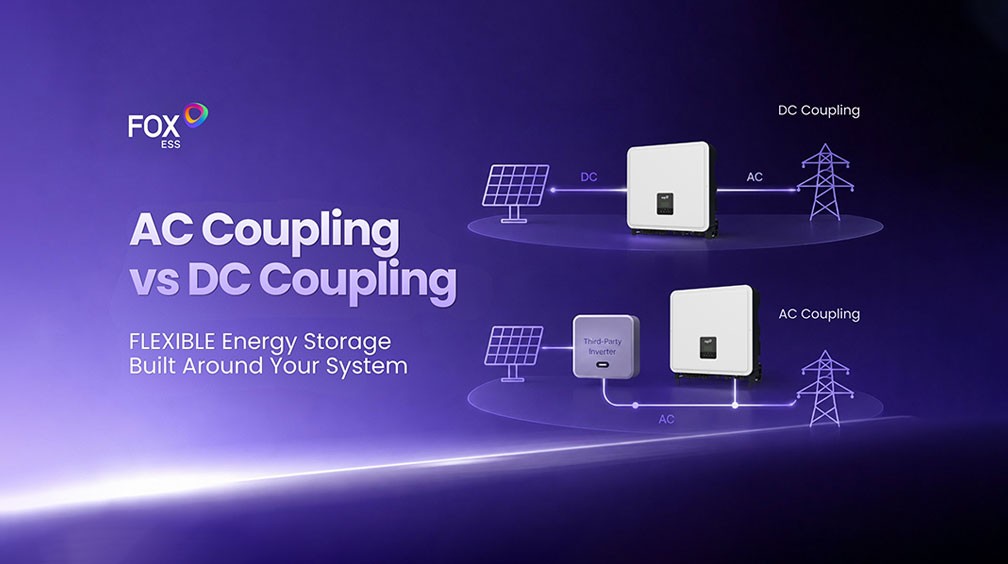
An AC-coupled battery system connects the battery to the AC side of the home’s electrical system, alongside the existing PV inverter.
Solar panels generate DC electricity, which the PV inverter converts into AC for use in the home. In an AC-coupled system, a separate battery inverter converts excess AC electricity back into DC for storage. When the stored energy is later used by the home, it is converted from DC to AC again.
AC coupling is commonly used to retrofit battery storage to an existing solar system. It is often well suited to homes with a suitable, functioning PV inverter because the inverter can usually remain in place. This can limit changes to the existing PV system, although additional metering, protection or backup equipment may still be required.
What Is a DC-Coupled System?
A DC-coupled system integrates solar generation and battery storage through a hybrid inverter.
In this setup, the solar power feeds directly into a hybrid inverter. Because the battery also stores energy in DC, the hybrid inverter can route the excess solar energy directly into the battery on the DC side. When solar energy is stored directly in the battery, a DC-coupled system can avoid some of the intermediate conversions required by a typical AC-coupled configuration. The hybrid inverter only converts the DC power to AC when the energy is actually needed by your home appliances or exported to the grid.
A DC-coupled architecture is an ideal choice for new solar installations. It is also a practical option when replacing an aging or out-of-warranty PV inverter, as it enables a more integrated and future-ready system design.
AC-Coupled vs DC-Coupled: Pros and Cons
Here are the pros and cons of AC-coupled and DC-coupled systems:
| Approach | Pros | Cons |
|---|---|---|
| AC-Coupled | • Easier to retrofit with an existing PV system • Can retain a suitable existing PV inverter • Flexible for different system configurations | • Requires a separate battery inverter • Additional power conversions can increase energy losses • May require more equipment and installation space |
| DC-Coupled | • Fewer power conversions can improve efficiency • Integrated solar and battery management • Cleaner, more compact system design | • Less flexible for retrofitting existing PV systems • Requires compatible hybrid inverter and system components |
AC coupling is generally a practical path for adding storage to a suitable existing solar system, while DC coupling is often a better fit when solar and storage are being installed or redesigned together. The right choice depends on the existing inverter, installation scope, backup needs, and long-term energy plans.
How to Choose: AC-Coupled or DC-Coupled?
Both architectures are technically sound. The right choice depends largely on the current state of your solar systems and your long-term energy goals.
Choose AC-Coupled If:
• Keeping a functioning string inverter and still under warranty
• Adding a battery without altering existing rooftop DC wiring, isolators, or conduits
• Protecting grandfathered solar feed-in tariffs and legacy grid-connection agreements
• Completing a fast, non-invasive solar retrofit with minimal on-site electrical rework
• Seeking a flexible AC-coupled battery system that pairs with any third-party PV inverter
Choose DC-Coupled If:
• New solar and battery installations designed from the ground up
• Expanding your rooftop solar array to meet growing loads like EVs or heat pumps
• Properties needing a cleaner single-box equipment layout with minimal wall clutter
• Installations where maximizing round-trip conversion efficiency is a primary goal
• Homeowners wanting fully integrated EPS backup and unified monitoring via a single APP
Which Fox ESS Storage Option Fits Your Home?
Fox ESS offers both AC-coupled and hybrid inverter options for different residential power and phase requirements. For homeowners adding battery storage, the first decision is whether to retain the existing PV inverter or replace it with a hybrid inverter.
If You Want to Keep the Existing PV Inverter
An AC-coupled system can often add battery storage while leaving a suitable PV inverter in place. Representative Fox ESS options include:
• AC1-G2: a 2.5–6 kW single-phase AC-coupled inverter for standard residential systems
• AC3: a 5–10 kW three-phase AC-coupled range for compatible three-phase installations
This route may suit homeowners whose existing solar system is operating reliably and does not require an inverter replacement.
If You Are Replacing the Inverter or Installing Solar and Storage Together
A Fox ESS hybrid inverter integrates solar generation and battery storage on the DC side. Representative options include:
• H1-G2: 2.5–6 kW for standard single-phase homes
• KH: 7–10.5 kW for higher-demand single-phase homes
• H3 Smart: 5–15 kW for three-phase residential systems
• H3 Pro: 15–30 kW for larger homes and selected light-commercial applications
This route may be more suitable when the existing inverter is due for replacement, the solar array is being expanded, or the homeowner wants solar and battery storage designed as one integrated system.
FAQs
1. Can I add a battery to my solar system without replacing my inverter?
Yes, absolutely. By using an AC-coupled battery system, you can add a battery to an existing solar system without needing to replace your existing, functioning solar inverter.
2. Will an AC-coupled battery lower my solar efficiency?
No, it will not lower the efficiency of your solar panels generating power. However, because the energy must be converted from AC back to DC to charge the battery, there are slight conversion losses in the storage process compared to a direct DC-coupled system.
3. Can both AC-coupled and hybrid systems take advantage of smart time-of-use tariffs?
Absolutely. Both architectures support intelligent grid scheduling via the FoxCloud 2.0 APP. Homeowners can program the battery to charge from the utility grid during low-cost or negative-price off-peak overnight hours, subsequently discharging to power home circuits during expensive peak demand windows.
4. Is it cheaper to retrofit with AC-coupling or replace with a hybrid?
Often, yes—if the existing PV inverter is still suitable, AC coupling can reduce upfront costs by allowing it to remain in place. If the inverter already needs replacement, however, a hybrid inverter may be the more practical option. The final comparison should be based on complete installation quotations.
Summary
When weighing AC-coupled and DC-coupled technologies, there is no universal “better” answer—only the system architecture that aligns with your equipment’s operational lifecycle.
At Fox ESS, we support both pathways so homeowners and installers can build storage around the existing system, electrical configuration, and future energy needs. Explore our residential storage systems to engineer the ideal energy storage solution for your home.