








A winter outage can turn routine household loads into competing priorities. A well-planned solar battery backup system should first protect the services that matter most: safe heating operation, refrigeration, communication, essential lighting, and any medically necessary equipment.
The right design then depends on how much energy those loads use, how much power they draw at the same time, and whether winter solar production can recharge the battery. This guide explains how to prioritize loads, estimate backup needs, and extend runtime before selecting a home battery backup system.
Key Takeaways
1. Winter home battery backup planning should begin with essential household loads rather than the total number of appliances in the home.
2. Battery capacity determines how much energy is available, while inverter output and surge capability determine which devices can run together.
3. Runtime improves when households limit high-demand loads, stagger flexible use, and use available daylight solar strategically.
4. Fox ESS combines single-phase or three-phase hybrid inverters with scalable residential batteries to support different household backup goals.
What Should You Keep Powered During a Winter Outage?
There is no universal winter backup list because medical needs, heating systems, water supplies, and local weather risks vary by household. A practical plan starts by deciding which loads should stay on, which can run only when needed, and which should remain off. Most home battery backup systems are configured around selected rooms or appliances rather than every circuit, so the priority list should reflect safety, habitability, communication, and property protection.[1,2]
| Priority | Typical loads | What to do |
|---|---|---|
| Keep powered | Medical equipment, heating controls, refrigerator, essential lighting, Wi-Fi, and phone charging | Keep available throughout the outage, and include medically necessary devices in a separate household emergency plan. |
| Use selectively | Pumps, computers, televisions, and selected kitchen appliances | Run only when needed. For pumps or compressors, account for starting power before adding them to the backup plan. |
| Switch off or limit | Electric space heaters, ovens, dryers, water heaters, and EV charging | Avoid unless specifically included in the backup design because these loads can consume stored energy quickly. |
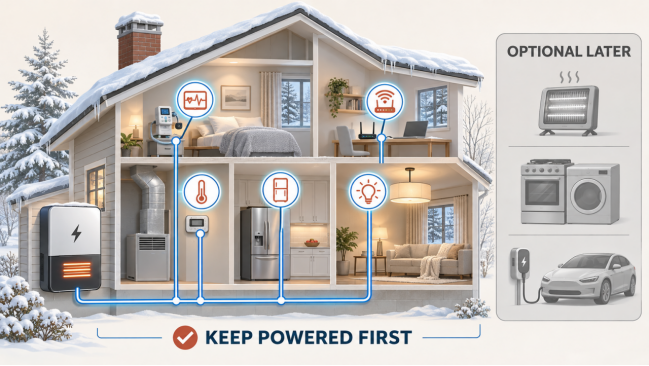
Practical note: Assess heating loads separately. Keeping a thermostat, control board, circulation pump, or furnace blower operating is not the same as powering resistance-based space heaters throughout the home. Before an outage, confirm which heating components are connected to backed-up circuits and whether their running and starting power requirements fit the system.
Once the three groups are clear, record the running power, expected operating time, and starting power of each selected device. Those figures determine the battery capacity and inverter output required when planning a battery backup for home use.
How Much Solar Battery Backup Does Your Home Need?
A house battery backup system must be sized for both energy and power. Use the two figures together rather than treating battery capacity as the only sizing decision:
1. Energy (kWh): indicates how long the selected loads can be supported.
2. Power (kW): determines how many loads can operate at the same time, including brief starting demand from motor-driven equipment.
Calculate the Energy Your Essential Loads Use
Build the estimate from the backed-up devices rather than total household consumption:
1. Record operating power. Use the normal running power for each selected device.
2. Estimate operating time. Account for both continuous use and the duty cycle of equipment that turns on and off.
3. Calculate energy demand. Apply the same time window to every load before adding the results.
Energy required (kWh) = power (kW) x operating time (hours)
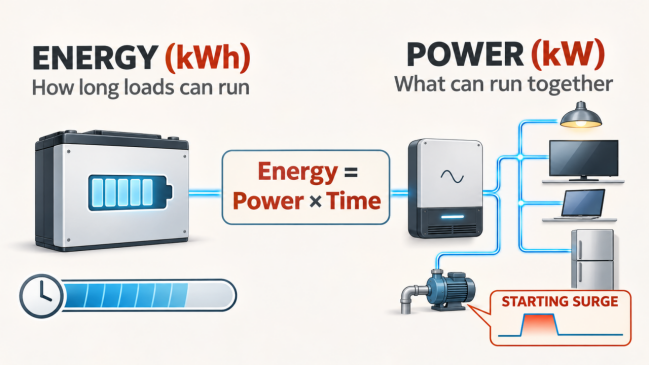
Add the results, then account for usable battery capacity and conversion losses. Appliances such as refrigerators, pumps, and heating controls may cycle rather than run continuously, so their expected duty cycle matters. This method produces a more realistic starting point than assigning a fixed number of backup hours to a battery's nameplate capacity.
Check Continuous Output and Starting Power
Capacity and output answer different questions, so check two power figures after estimating energy demand:
1. Continuous output: the combined power the inverter must supply while the selected devices operate together.
2. Starting or surge power: the brief additional demand created when pumps, compressors, or other motor-driven equipment starts.
A battery may hold enough energy for the planned duration while the inverter output remains too low for the selected load combination. This distinction is especially important when a battery backup for home use includes refrigeration, pumps, or heating equipment.
Allow for Winter Solar Conditions and Backup Reserve
Backup duration changes with battery size, household use, and available solar generation.[2] In winter, apply that principle in three ways:
1. Daylight generation: shorter days, cloud cover, shading, or snow can reduce the energy available for recharging.
2. Overnight demand: the battery supports selected loads without immediate solar input.
3. Backup reserve: before forecast severe weather, review the backed-up circuits and raise the stored reserve when the system settings allow it.[2]
Taken together, the load list, runtime target, simultaneous demand, and expected winter recharge provide the design brief for the solar battery backup system. During an outage, how those loads are managed will then determine how long the stored energy actually lasts.
How Can You Make Your Home Battery Backup Last Longer During an Outage?
Longer runtime comes from using stored energy deliberately. Follow this checklist to keep essential services available while adapting to the weather, solar production, and remaining battery charge:
1. Keep priority loads running first. Protect medically necessary equipment, safe heating controls, refrigeration, essential lighting, and communications before adding flexible loads.
2. Switch off high-demand loads. Electric space heaters, ovens, dryers, water heaters, and EV charging can shorten runtime quickly unless they were included in the system design.[2]
3. Stagger flexible devices. Run pumps, selected kitchen appliances, computers, and other optional equipment at different times to reduce simultaneous demand and leave headroom for motor starting power.
4. Protect refrigeration efficiently. Keep refrigerator and freezer doors closed and avoid repeated opening so stored food remains cold without unnecessary energy use.[1]
5. Use available daylight solar strategically. When the system is designed for outage operation and sunlight is available, solar can support active loads and replenish the battery. Schedule flexible use after essential needs are covered.[3,4]
6. Monitor remaining energy. Compare the current load with the expected outage duration and reduce optional use early if the remaining charge is dropping faster than expected.
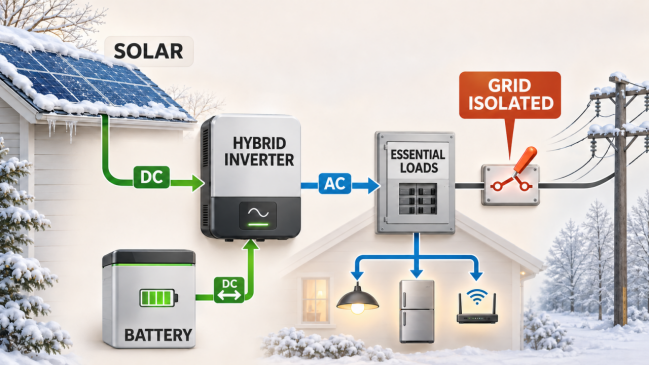
These steps preserve stored energy for the loads that matter most. For charging schedules, reserve settings, and day-to-day winter operation, see How to Use Your Home Battery More Effectively in Winter.
How Can Fox ESS Support Different Home Battery Backup Needs?
Fox ESS supports different residential backup needs with hybrid inverters, scalable high-voltage batteries, and EPS capability. The table below shows how these options map to common household requirements. Product availability, compatible battery combinations and backup configurations vary by market. A qualified installer should confirm the applicable products and local electrical requirements before system selection.
| Household requirement | Fox ESS solution | Practical value |
|---|---|---|
| Single-phase homes | Fox ESS H1-G2 single-phase hybrid inverter[5] | Offers models from 2.5 to 6 kW and EPS output with a battery, allowing the inverter rating to be aligned with selected residential loads. |
| Three-phase homes or broader power requirements | Fox ESS H3 Smart three-phase hybrid inverter[6] | Provides 5 to 15 kW models with three-phase EPS output for homes whose electrical configuration or simultaneous demand calls for a three-phase solution. |
| Longer runtime or future capacity growth | Fox ESS EP12 high-voltage LFP battery[7] | Provides 11.52 kWh nominal energy per unit and supports up to four units in parallel, enabling capacity from 11.52 to 46.08 kWh. |
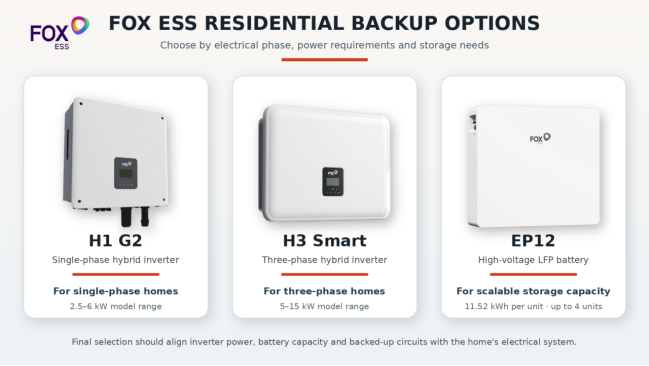
For a coherent residential backup design:
1. Match inverter power to the home's phase arrangement and simultaneous backed-up loads.
2. Choose battery capacity for the intended runtime rather than from a nameplate figure alone.
3. Coordinate the complete system so the inverter, battery, EPS connection, and backed-up circuits work as one residential energy system.
Together, the single-phase, three-phase, and scalable storage options allow a system to grow from essential-load coverage toward whole-home battery backup as household requirements change. The installer should confirm the final design against the home's electrical service and backed-up circuits.
Build a Winter Home Battery Backup Plan with Fox ESS
A reliable winter backup plan gives stored energy a clear order of use: essential services first, flexible loads when needed, and high-demand appliances only when available capacity allows. Review that plan before severe weather and monitor remaining energy throughout an outage.
Fox ESS residential energy storage solutions can then be configured around these priorities, helping households monitor available energy and direct backup power to the loads that matter most.
Explore Fox ESS residential energy storage solutions, compare single-phase and three-phase hybrid inverters, or contact Fox ESS sales, support, and service to plan a system around your home's electrical service, backup circuits, and runtime target.
Fox ESS Winter Home Battery Backup FAQs
What should I power first during a winter outage?
Start with medically necessary equipment, safe heating operation, refrigeration, essential lighting, communication, and any equipment that prevents property damage. Then decide which comfort or work-related loads can operate intermittently. A home battery backup lasts longer when high-demand appliances are not treated as continuous priorities.
Can a home battery run an electric heater during an outage?
It may, but the answer depends on the heater's power, the hybrid inverter's continuous output, the battery's usable capacity, and the other loads running at the same time. Resistance-based space heaters can consume stored energy quickly. Heating controls, circulation pumps, and furnace blowers should be assessed separately from whole-home electric heating.
How long does solar battery backup last during a winter outage?
Runtime depends on usable battery capacity, the power and duty cycle of the backed-up loads, reserve settings, and whether solar can recharge the battery. Reducing high-power or optional loads can preserve energy for essential devices, especially overnight or during cloudy winter weather. For broader seasonal charging and reserve strategies, consult the Fox ESS winter home battery guide.
Can solar panels recharge a home battery during a power outage?
Yes, when the solar-plus-storage system includes a properly configured hybrid inverter, battery, isolation method, and backup operating mode. Standard grid-tied solar may shut down when the grid fails. A complete house battery backup system is designed so available solar generation can support selected loads and recharge storage under suitable conditions.
Does Fox ESS offer integrated residential backup solutions?
Yes. Fox ESS offers single-phase and three-phase hybrid inverters alongside scalable high-voltage batteries. These components can be configured for essential circuits or a whole-home battery backup plan, depending on the home's electrical system, intended runtime, and backup power requirements.
References
[1] FEMA, Be Prepared for a Power Outage. https://www.ready.gov/sites/default/files/2024-08/ready.gov_power-outage_info-sheet.pdf
[2] PG&E, Residential Battery Storage. https://www.pge.com/en/clean-energy/battery-storage.html
[3] U.S. Department of Energy, Solar and Resilience Basics. https://www.energy.gov/cmei/systems/solar-and-resilience-basics
[4] Pacific Northwest National Laboratory, PV Battery Storage for Power Outages. https://basc.pnnl.gov/information/pv-battery-storage-power-outages
[5] Fox ESS, H1 G2 Datasheet. https://www.fox-ess.com/Public/Uploads/uploadfile/files/20260612/ENH1G2DatasheetV2.220260609.pdf
[6] Fox ESS, H3 Smart Datasheet. https://www.fox-ess.com/Public/Uploads/uploadfile/files/20260612/ENH3SmartDatasheetV2.020260609.pdf
[7] Fox ESS, EP12 Datasheet. https://www.fox-ess.com/Public/Uploads/uploadfile/files/20251203/ENEP12DatasheetV1.120251128.pdf